Almost everyone who opens a block explorer is asking one thing: when will my transaction confirm? The usual answer is a fee rate and a place in a queue. Measuring what that queue is actually made of gives a better answer, and a more reassuring one.
Blocks and the mempool are opposites
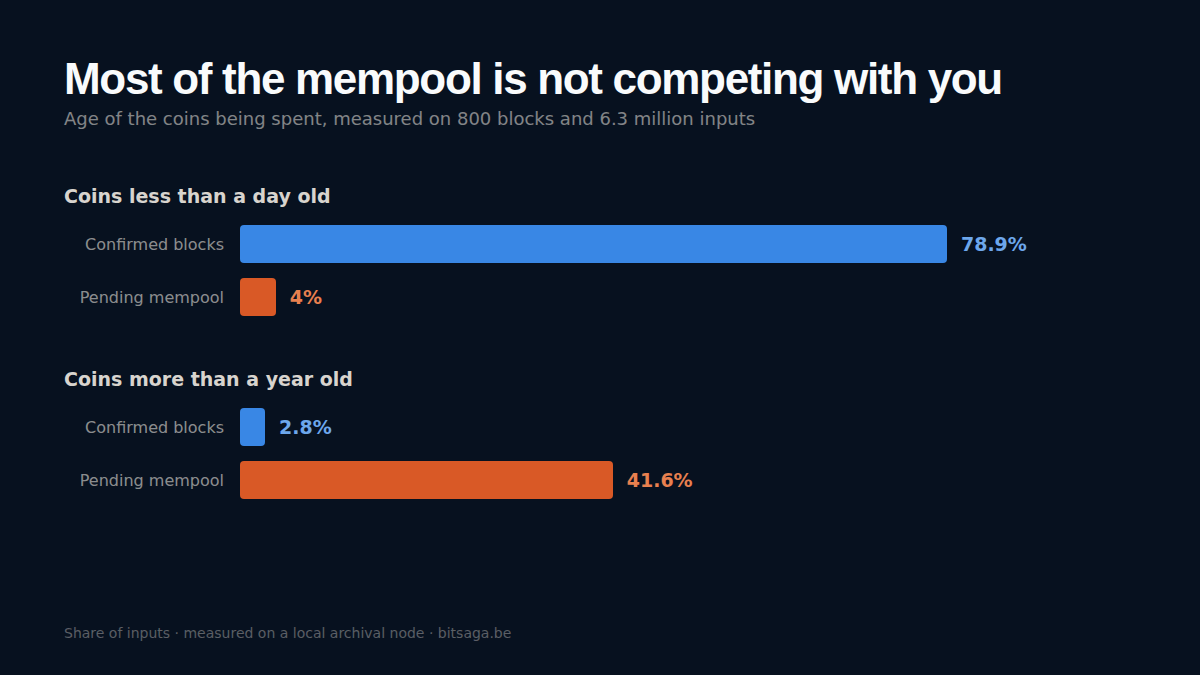
Across 800 consecutive blocks, holding 3.8 million transactions and 6.3 million spent coins, confirmed Bitcoin is overwhelmingly fresh:
| Age of the coin when spent | Share of inputs in blocks |
|---|---|
| Under 1 hour | 50.8% |
| Under 1 day | 78.9% |
| Over 1 year | 2.8% |
Sample the pending mempool at the same moment and it inverts: barely 4% of pending inputs are under a day old. Transactions paying competitive fees pass through too quickly to be caught in a snapshot. What piles up is what nobody is in a hurry to mine.
The mempool is not a preview of the next block. It is the residue of everything that did not make it into the last ones.
Two percent of transactions, a third of the queue
In a sample of 1,200 pending transactions, those spending a coin older than a year were just 2% of the transactions but carried 28.8% of all the inputs. Two of them had a thousand inputs each. They paid a median of 0.20 sat/vB, the lowest fees in the pool: dust consolidations, sweeping up hundreds of tiny old outputs, deliberately paying as little as possible and content to wait days.
So a large part of what looks like a queue ahead of you is not competing with you at all. Only the backlog at or above your own fee rate decides when you get mined, and that number is usually far smaller than the headline mempool size.
Why nobody publishes their accuracy
There is a structural reason, and it is not modesty. The blockchain never records when a transaction entered the mempool. It records the block it landed in and nothing about the wait before it. That exists only inside each node, only while the transaction is pending, and it is discarded the moment it confirms. A confirmation-time model therefore cannot be tested against history, and no archive can be reconstructed. The only way to get the data is to record it continuously and wait.
That recording is now running here, and the accuracy of these predictions will be published once there is enough of it to mean anything, including where they are wrong.
Measured with one unauthenticated call per block to a local Bitcoin Core node with
txindex enabled. No third-party API, no chain-analysis service.