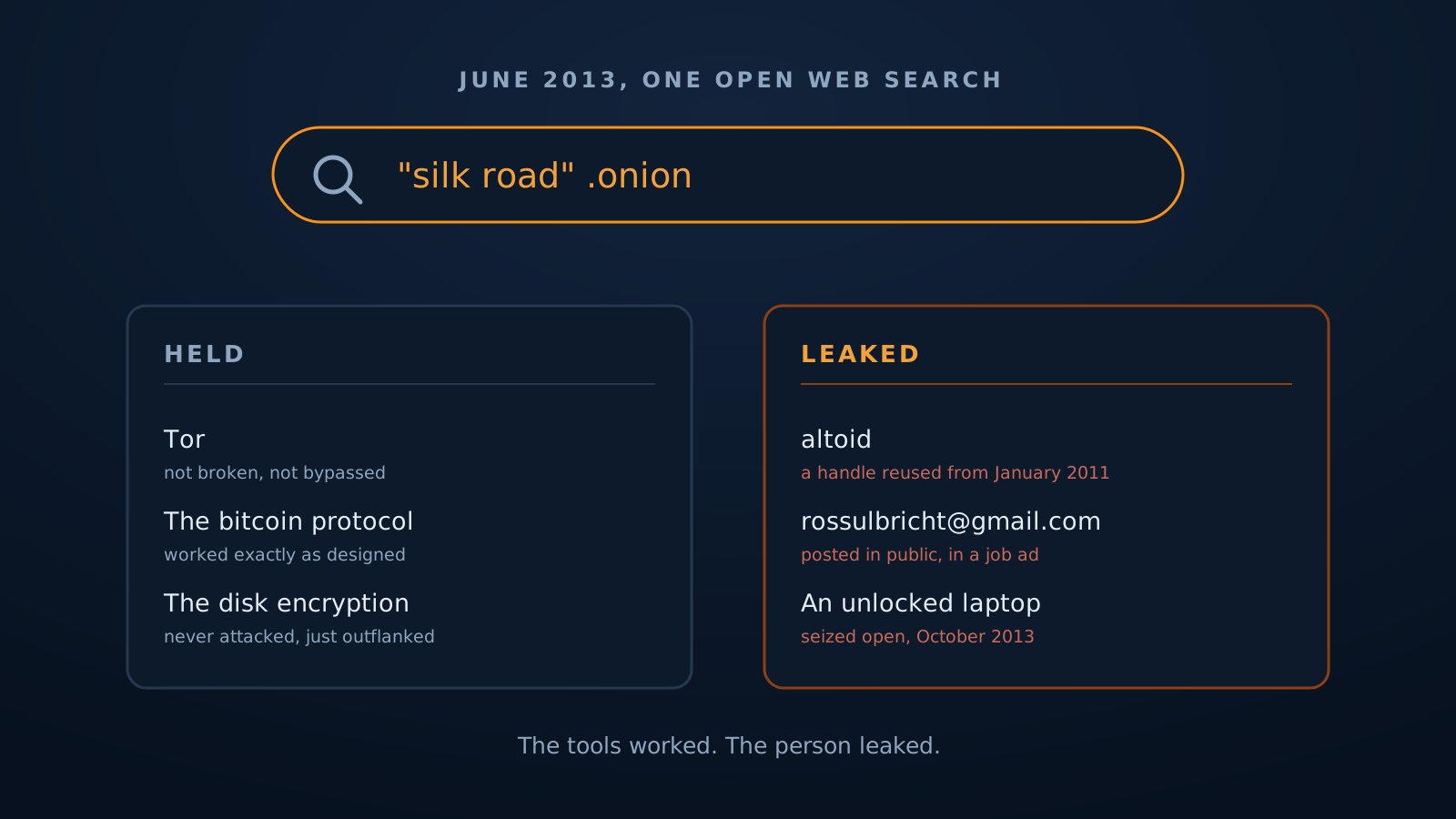
In June 2013, an IRS agent named Gary Alford typed "silk road" .onion into Google.
He was not running an exploit. He had no zero-day, no seized server, no informant. He was reading the open web, looking for the earliest mention of a site that by then was moving hundreds of millions of dollars a year. One result was a January 2011 post on bitcointalk.org from a user called altoid, plugging a new marketplace nobody had heard of yet.
The same handle had posted a job ad months later. That one said: send your answers to rossulbricht at gmail dot com.
Three clicks. That was the end of it.
Tor held. Bitcoin held. The handle did not.
This is the part I keep having to repeat. Silk Road's technical stack was not broken by Alford. Tor did its job. The bitcoin worked exactly as designed. Nothing in the cryptography failed.
What failed was everything around it:
- A reused handle. altoid existed before Silk Road did, in a context connected to a real person.
- A real email address, typed by hand, in public, for convenience.
- An unlocked laptop. On 1 October 2013 agents staged a shouting match in the Glen Park library in San Francisco. Ulbricht looked up. Someone took the machine while it was open and logged in. Full disk encryption protects a powered-off device. His was not powered off.
Two years of discipline, undone by a forum post written before the thing he was hiding even existed.
He is not the exception. Four takedowns, four different floors of the same building:
| Case | What caught them | The rule |
|---|---|---|
| Sabu, LulzSec, 2011 | One IRC login not routed through Tor | There is no "just this once" |
| Ulbricht, Silk Road, 2013 | A handle reused from before the site existed | Compartmentalise before you start, not after |
| Benthall, Silk Road 2.0, 2014 | An undercover agent inside the support staff | No cryptography survives a trusted insider |
| Scattered Spider, 2026 | A Windows device ID that no VPN could change | Network anonymity is not identity anonymity |
You are only as anonymous as your weakest layer
The way I think about it, anonymity is not a setting. It is a stack, and you are only as anonymous as the weakest floor of it: the network you connect from, the device you connect with, the identity you sign in as, the money you move, and the body that has to be somewhere at some time.
| Layer | What identifies you | What people think fixes it |
|---|---|---|
| Network | IP, DNS, traffic timing | A VPN |
| Device | Hardware serials, operating system telemetry IDs | Incognito mode |
| Identity | Handles, email addresses, KYC records | A new account |
| Money | The permanent public ledger | A coinjoin on its own |
| Physical | Your body, at a place, at a time | Nothing on this list |
Fixing one floor does nothing for the others. A VPN changes your IP and changes nothing about the account you are logged into. Tor hides where you connected from and hides nothing about the username you chose. This is why almost every takedown reads the same way: the tools worked, the person leaked.
And it is retroactive. This is the genuinely harsh part. A mistake you made in 2011 does not expire. It sits in a search index, an archive, a database dump, waiting for someone with a reason to look. You cannot patch your past. You can only avoid adding to it.
So let me be blunt: you are almost certainly not anonymous, and you are not going to become anonymous. Real anonymity means a dedicated device, a network that is not yours, an identity with no history, and never once, not a single time, mixing it with the life you actually live. Almost nobody sustains that. What you can realistically do is make yourself expensive to find. That is a lower bar, and it is worth clearing.
Why this hits bitcoin harder than anything else
Every other adversary needs to keep logs. An IRC server has to retain them. An ISP has to be subpoenaed. A phone company has to be asked.
The bitcoin ledger is not like that. It is a permanent, public, indexed record of every payment ever made, held by thousands of machines, free to query, and it does not forget. Nobody has to preserve the evidence, because the evidence is the database. We run our own archival node and publish the analytics from it, and so does every chain-analysis firm with a government contract. The difference is what they pair it with.
Because on its own the chain is pseudonymous, not identified. Bitcoin is not anonymous and was never advertised as such. It only becomes identified where it touches your name. That touch has a name: KYC.
Your KYC record is your altoid post. It is the one durable link between a string of addresses and a person, it was created for convenience, and it sits in a database you do not control, for years. When a Dutch court ordered Bitfinex to surrender customer data in five days, nothing was hacked. The data was always there. Someone finally asked.
The 2026 case in that table is the clearest version of this ever put in a court filing. The suspect used a commercial VPN and a tunnelling tool, and the VPN worked: his IP changed on every connection. What did not change was his Global Device Identifier, a server-side ID that Microsoft assigns to a single Windows installation signed into a Microsoft account. Investigators matched that one ID loading a signup page in the same minute an account was created, then found it again across four countries over eight months.
A coinjoin is the VPN. Your KYC record is the device ID. One changes where the coins appear to have come from. The other does not change at all.
What actually moves the needle
Not a checklist to feel good about. Four things I would actually do, in rough order of payoff:
- Stop feeding the link. Where you buy matters more than what you do afterwards. Some routes create a permanent identity record and some do not: see how to buy bitcoin for the ones we use, and kycnot.me for a maintained, openly rated directory of services by how much identity they demand.
- Run your own node. If you query someone else's server for your balance, you have handed them your addresses, your IP and your timing, all at once. Point your wallet at our node over Tor if you are not ready to run one, and run your own when you are.
- Break the chain deliberately. Coinjoin is still the only tool I know of that makes on-chain history genuinely ambiguous rather than merely inconvenient. coinjoin.nl runs a WabiSabi coordinator for Wasabi Wallet at a 0% coordinator fee, non-custodial, hardware-wallet compatible, with weekly rounds. Your keys never leave your wallet, the coordinator cannot link your inputs to your outputs, and a failed round costs you nothing at all.
- Never reuse an address. This is the altoid mistake in miniature. One reused address links two payments forever. Silent payments fix it at the protocol level: one published name, a fresh address for every payment, no coordination, and they now run on a signing device you can hold.
And the one that costs me nothing to recommend: keep your bitcoin life and your named life apart. Different devices, different identities, no crossover, no exceptions. The exception is always the thing that catches you. If you are choosing the device that holds the keys, our hardware wallet guide is deliberately critical about which ones earn that trust.
Mixers are not coinjoins
The standard warning against "mixing" services is correct, and it does not apply to what I recommend above. A custodial mixer takes your coins, can be statistically unmixed, and places you inside someone else's money-laundering exposure. A non-custodial coinjoin never holds your keys and cannot pay itself.
The difference is not academic. In April 2024 the Samourai coordinator was seized and its founders charged. Users were advised to assume their wallet identifiers were in the hands of investigators and that past mixes could be unwound. Sparrow removed the client within weeks.
So the question is never whether coinjoin is safe. It is who runs the coordinator, and what they hold while they do it. At coinjoin.nl the answer is nothing of yours.
Every link you make is permanent
Ulbricht did not lose because he was careless with cryptography. He lost because two years earlier he was in a hurry and wanted people to email him.
You hold an asset that is permanently, publicly auditable, and the ledger will outlive you. Assume every link you create is forever, because it is. Then decide, deliberately, which ones you are willing to create.