Silent payments give bitcoin one unchanging address nobody can watch. The catch: finding your money means trusting a helper server that can quietly hide payments from you. We run one that publishes proof of everything it serves.
A normal bitcoin address is a diary you did not mean to keep: post it once and everyone who ever pays you can see everyone else who did, how much, and when. Silent payments cut that thread: publish one address for life, and every payment lands on a fresh address only your wallet can spend from, unlinkable to the rest. We wrote about publishing such an address as a name you can actually type.
The catch: somebody has to look for your money
Because every payment arrives on a brand new address, your wallet cannot simply look up its coins; something has to scan every chain transaction and work out which outputs are yours. A full node does this fine. A phone cannot, so it leans on a helper server, and today that server must be trusted twice.
Trust one: some helpers see everything. The most common design hands the server your scan key, which cannot spend your coins but reveals every payment you will ever receive.
Trust two: every helper can hide payments from you. Your wallet only learns about payments the server chooses to mention, and no current design lets it check it was told everything. One omission, malicious or a plain bug, silently denies you your own money. It has already happened, and it cost real users real money.
What we run
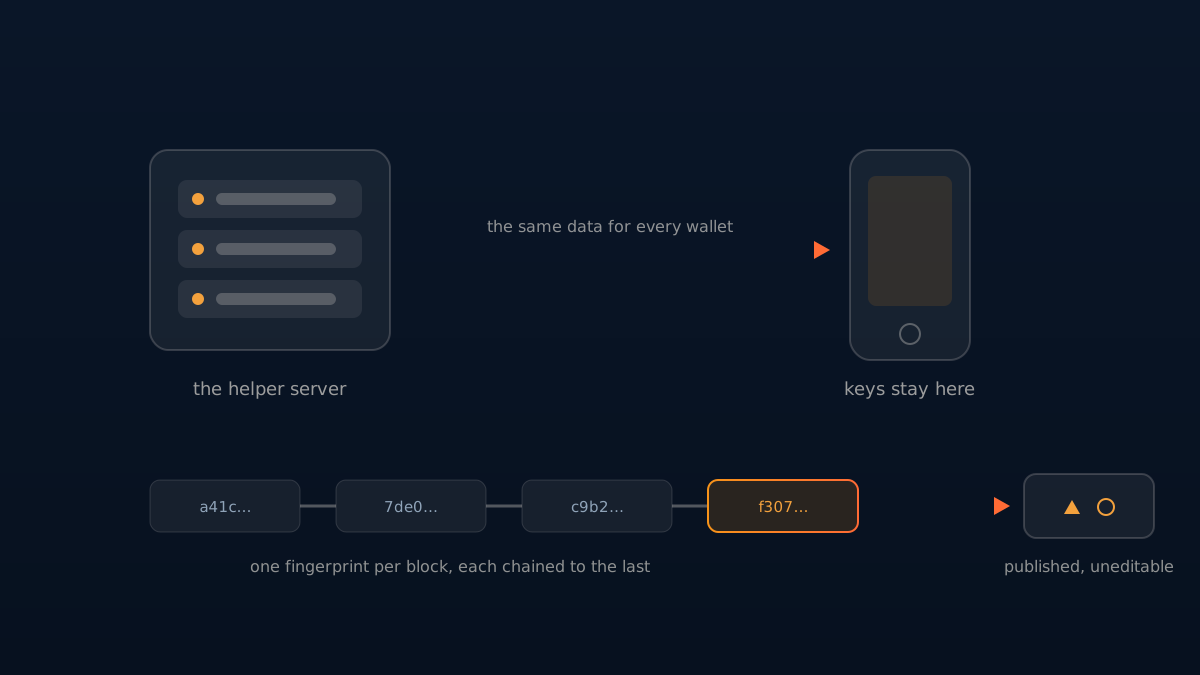
Since the first of September we run a public helper server of the rarer kind: one that never learns which payments are yours. It serves every wallet the same small piece of per-transaction scanning data; the matching happens on your phone, with keys that never leave it. Only two public servers of this kind exist, and ours is the only one covering the full history since taproot activated in November 2021: 255,434 blocks, 187.8 million of the values wallets scan against. It is verified against the official BIP-352 reference implementation, against the other public server, and against a real payment found blind with nothing but a wallet's own keys.
Caught lying, by design
Verification proves the index was right yesterday; it does not stop a server lying tomorrow, and trust two is precisely lying by omission.
So every six hours the server publishes tamper-evident fingerprints of everything it serves: one per block, each chained to the previous, the head of the chain signed into public venues we do not operate and cannot edit. The publishing tool refuses to sign a chain it cannot recompute from the data itself.
We would rather scope what that buys honestly than oversell it. It does not make lying impossible. It makes lying detectable and attributable: drop a payment and the data no longer matches the published fingerprint, and anyone, including a rival server, can prove the discrepancy to a third party. It is the strongest promise anyone in this category can honestly make, and no silent payments server has made it before.
What private receiving costs a phone, measured
The developer discussion on standardising light wallets for silent payments stalled in June 2024 waiting on one number: how many bytes per day does following the chain privately cost a phone? Running the full index made measuring cheap, so we measured, across all 255,434 blocks with no sampling.
| What the phone downloads daily | Per day |
|---|---|
| the stock block filter light wallets use today (BIP-158) | 2.84 MB |
| a filter tailored to silent payments (proposed in 2024, never built) | 0.44 MB |
| the complete scanning payload our server ships (BlindBit v2) | 8.04 MB |
At 144 blocks a day, using recent-era averages. The tailored filter the 2024 discussion asked about is about 6.1 times smaller than the stock filter wallets already download. The complete payload looks extravagant until you add what a filter wallet must also fetch: about 7.1 GB over the whole history against the payload's 15.1 GB, roughly 2.1 times the bytes, for zero false positives and no block downloads. The often-quoted 6.2 GB is only the raw scanning values; a real server's full index is 109 GB. Every figure is reproducible from our published per-block data and reproduction scripts.
Open today, Tor-only
Since 2 September the server is reachable, as a Tor onion service. Tor-only is deliberate for this preview phase: the service gets a stable, self-authenticating address, and nobody's connection to it is visible to anyone in between.
jelbugvogknkkxuwyacgl5tfzoooaidz6kbj4cyuehog67yidhd3ylid.onionPort 8010 answers the HTTP API, port 8011 the gRPC one that BlindBit-family wallets speak. This is a preview for people comfortable with command-line tools: blindbit-cli through torsocks works today, and we verified a full wallet scan through the onion found a real payment. Point-and-click wallet support arrives with the clearnet endpoint.
What happens next
The measurements go back to the standards discussion. The server, verified and fingerprinted, moves to dedicated hardware and opens to the public on clearnet soon. Receiving bitcoin privately should not require blind trust in a stranger. Publish one address for life, and let a lookout that cannot see you, and cannot quietly lie to you, do the watching: silentpayments.net.