
Here is what is actually being debated.
There is no rule change to Bitcoin’s consensus.
No coins are at risk. Your Bitcoin is not being redefined.
This is a node policy debate, not a protocol debate.
Bitcoin Core
Bitcoin Core is the reference implementation used by the majority of the network.
Core’s policy is designed around:
Maximum network reliability
Fast block propagation
Minimizing permanent chain damage (especially UTXO bloat)
Policies that reflect what miners already accept
Core does not try to morally judge transactions.
It only tries to make spam as cheap to clean up as possible.
Bitcoin Knots
Bitcoin Knots is a fork of Core that adds extra relay filters. Knots tries to:
Block certain transaction patterns
Restrict OP_RETURN usage
“Clean” the mempool from things it considers spam
These filters do not change Bitcoin’s rules; they only affect:
What your node relays
What your node personally sees
Miners and alternative relay networks simply bypass these filters.
Why OP_RETURN Limits Don’t Stop Spam And Never Did
Filters don’t work. Economics do.
It doesn’t matter how many percent of nodes run Core: even at 100%, miners can trivially bypass policy filters via alternative relay networks (for example Nostr-style networks). That is the fundamental reason spam filters do not work in open networks:
They only affect your mempool, not the network.
Spam does not live only in OP_RETURN.
OP_RETURN has existed since 2014 as a designated trash bin. Read the original release notes, that was literally its purpose:
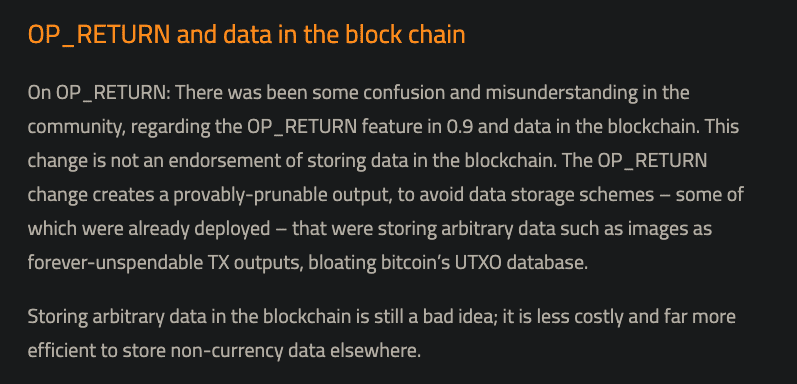
OP_RETURN is damage containment
It is the least harmful place to dump arbitrary data:
| Where spam goes | Why it matters |
|---|---|
| OP_RETURN | Prunable, minimal long-term harm |
| Fake outputs | Bloats the UTXO set (non-prunable, permanent damage) |
Bitcoin uses economic incentives to nudge spam into OP_RETURN instead of fake outputs because UTXO bloat is vastly more dangerous and harder to defend against.
Filtering UTXOs would be far more dangerous than allowing OP_RETURN data.
Opening OP_RETURN wasn’t “lowering standards”, it was damage reduction.
The fees are the filter
Spam is not stopped by byte limits.
Especially witness data gets abused because it’s cheaper.
Only economic incentives work in open networks.
The OP_RETURN size limit never had a solid technical justification in the first place.
Why the Change Was Made
Spammers were already bypassing OP_RETURN limits by:
stuffing witness scripts
creating fake outputs
→ causing UTXO bloat
Removing the limit:
improves block propagation (fewer compact-block failures)
aligns node policy with what miners already accept
reduces UTXO damage
increases network consistency
Nobody wants spam; the goal is to make it as harmless as possible.
Leaving the limit in place caused transactions to be chopped into multiple UTXOs → more UTXO bloat.
Removing it reduces permanent chain damage.
This is not “good vs bad.”
It’s flu vs cholera, and OP_RETURN is the flu.
Why Filters Are Actively Harmful
Knots-style filters:
Do not stop real spam
Do block legitimate privacy transactions such as:
BIP47 PayNym notifications
Samourai Whirlpool TX0s (>42 bytes OP_RETURN)
Filters always do this: they fail against attackers and punish real users.
Raising the OP_RETURN limit instead of removing it would just repeat the same cycle: new legitimate use cases would exceed the new cap, and the drama would start again.
🗑 If you have a trash bin, open it wide so the garbage stays off the street.
On Governance
The online debate is poisoned by people who don’t know the technical or historical context.
I actually understand how Core handled this.
Bitcoin is not a democracy.
It is a technocracy.
People with deep technical knowledge make the calls and that is a feature, not a bug.
You “vote” by running your own node but running Knots only affects your own mempool and changes nothing at the network level.
If things ever truly go off the rails, User Activated Soft Forks exists.
Final Note
I run Core.
But I’ll happily sell you a plug-and-play Start9 node so you can run Knots with one click.
It’s your right.
Just don’t confuse local filters with network-level reality.